
How Is Whisky Made? Complete Manufacturing Process
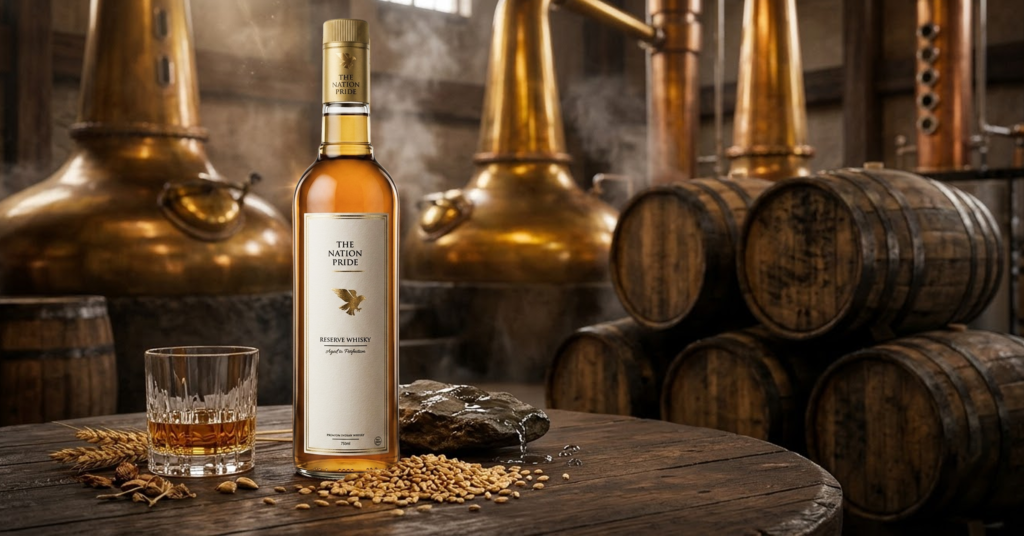
Whisky is a popular distilled alcoholic beverage that manufacturers create through a series of carefully controlled production stages. But have you ever wondered how simple grains, water and yeast become whisky? The answer involves several steps, including grain selection, malting, milling, mashing, fermentation, distillation and maturation.
Each stage contributes to the spirit’s final characteristics. For example, the choice of grains influences the raw material profile, while fermentation and distillation help develop the spirit’s composition. Moreover, maturation can add colour, aroma and flavour through interaction with wooden casks.
Understanding how is whisky made helps readers explore the science and traditions behind this spirit. In this guide, we will explain the essential ingredients, manufacturing stages, production methods and factors that influence whisky quality.
Definition and Production Process of Whisky
Whisky is a distilled alcoholic spirit that manufacturers produce from fermented grain-based ingredients. Common grains include barley, corn, wheat and rye. However, producers select different grains according to the whisky category and its manufacturing requirements.
The standard whisky production process involves several important stages:
- Grain selection and preparation
- Malting, depending on the production method
- Milling and mashing
- Fermentation
- Distillation
- Spirit selection
- Maturation
- Blending and bottling, where applicable
Each stage serves a specific purpose. Initially, manufacturers prepare the grains and extract fermentable sugars. Next, yeast converts those sugars into alcohol during fermentation. Afterward, distillation concentrates the alcohol and selected flavour compounds.
Finally, manufacturers may mature the spirit in suitable wooden barrels before bottling. Nevertheless, manufacturers do not produce all whiskies according to the same recipe.
Ingredients in Whisky Production
To understand how whisky is made, we should first examine its essential ingredients. Although the basic ingredient list remains relatively short, each component plays an important role in production.
1. Grains
Grains supply the starch that manufacturers need for whisky production. Producers select suitable grains according to their preferred whisky category and production method.
Common examples include:
- Barley: Malted barley supplies natural enzymes that help convert starch into fermentable sugars.
- Corn: American whiskey producers commonly use corn as a major grain.
- Rye: This grain contributes distinctive characteristics to certain whisky varieties.
- Wheat: Several whisky production methods use wheat as a primary or supporting grain.
Therefore, grain selection establishes the foundation for the entire manufacturing process.
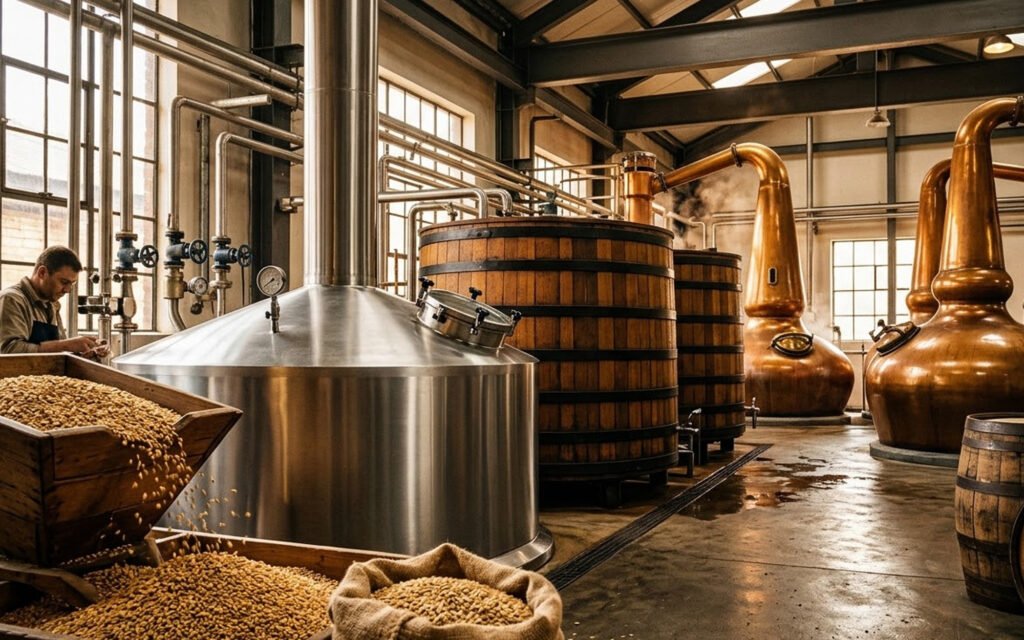
2. Water
Manufacturers use water during several production stages, especially mashing and dilution. First, they mix water with prepared grains to extract fermentable sugars. Later, they may add water to adjust the spirit to the desired bottling strength.
Water quality also matters because unwanted impurities can affect production. Consequently, manufacturers monitor their water sources and maintain suitable quality standards.
3. Yeast
Yeast plays an essential role in fermentation. It consumes fermentable sugars and produces alcohol and carbon dioxide. In addition, yeast activity creates other compounds that contribute to the developing spirit’s aroma and flavour profile.
The yeast strain, fermentation temperature and fermentation duration can all influence the final result. For this reason, manufacturers carefully manage these conditions.
4. Wooden Casks
Wooden casks play an important role in the maturation of many whisky varieties. During this stage, the spirit interacts with the wood and gradually develops colour, aroma and flavour characteristics.
Oak remains a common choice for whisky maturation. However, the final influence depends on several factors, including the type of wood, previous cask contents, cask condition and maturation period.
Whisky Manufacturing – How Is Whisky Produced? Major Stages
Now that we understand the main ingredients, let’s explore how manufacturers transform them into whisky. Each production stage has a specific purpose. Furthermore, changes in ingredients, temperature, equipment and processing conditions can influence the finished spirit.
Manufacturing Step 1: Grain Selection and Preparation
The manufacturing process begins with the selection of suitable grains. Producers examine grain quality, starch content and the requirements of the intended whisky category.
First, workers inspect the raw materials and remove foreign materials. They then clean and prepare the grains for the next production stages.
Malt whisky production generally uses malted barley. However, other whisky styles may use corn, wheat, rye or combinations of permitted cereals.
As a result, careful grain selection provides the starting point for the entire manufacturing journey.
Step 2: Malting Procedure
Malting plays an important role in many barley-based whisky production methods. During this stage, manufacturers soak barley in water and allow the grains to begin germination.
As germination progresses, natural enzymes develop and help prepare the starch for conversion during mashing. However, producers must stop germination at the appropriate stage.
To do this, they dry the germinated barley inside a kiln. Some producers use peat smoke during drying to develop smoky characteristics in the malt. Nevertheless, many whisky production methods do not use peat.
Once the drying process finishes, manufacturers obtain malted barley for the next stage.
Step 3: Milling the Grains
After malting, manufacturers crush the grains into smaller pieces. This process, known as milling, prepares the material for mashing.
The resulting mixture is called grist. Producers carefully control its texture because grain size affects sugar extraction and filtration.
For example, very large particles may reduce extraction efficiency. On the other hand, excessively fine material can make filtration difficult.
Therefore, suitable milling helps manufacturers prepare the grains for efficient mashing.
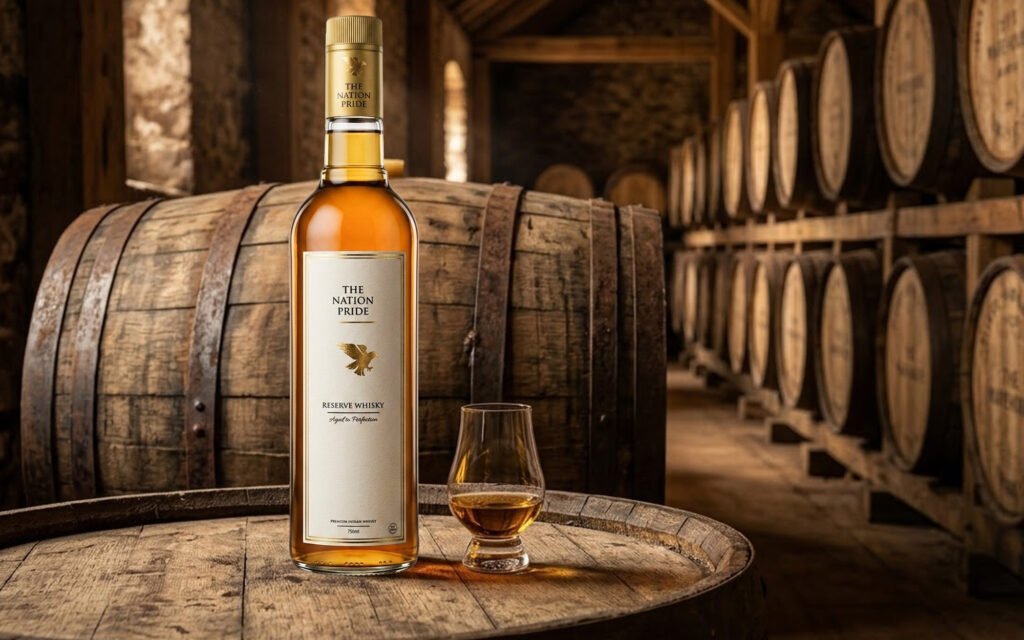
Step 4: Mashing Process
Mashing plays a crucial role in whisky production because it extracts fermentable sugars from the prepared grains.
During this stage, manufacturers mix the grist with hot water inside a large vessel known as a mash tun. Heat and natural enzymes convert grain starch into fermentable sugars.
Next, manufacturers obtain a sugar-rich liquid called wort from the mixture. Manufacturers separate this liquid from the remaining grain material before fermentation.
The leftover grain can also serve other purposes, including animal feed. Ultimately, effective mashing prepares the liquid that yeast needs for alcohol production.
Step 5: Fermentation Process
It is during this stage that the production of alcohol begins. The wort is now transferred to the fermentation tanks where the yeast is added.
This yeast then consumes the fermentable sugars to produce alcohol and carbon dioxide among others.
Also, the fermentation process parameters, including temperature, duration, and yeast used, determine the properties of the liquid produced.
During traditional whisky production, fermentation creates a beer-like liquid that manufacturers call wash.
But the fermentation period differs depending on the manufacturer and method of manufacture of whiskey. No single fermentation period can apply to all whiskey.
Finally, an alcoholic liquid is available for distillation.
Step 6: Distillation Process
Distillation separates and concentrates alcohol and selected flavour compounds from the fermented wash.
First, distillers heat the wash inside specialised equipment. As the temperature rises, alcohol and other volatile compounds turn into vapour. The equipment then cools the vapour and converts it back into liquid spirit.
Whisky manufacturers mainly use two types of distillation equipment.
Distillation using Pot Stills
Pot stills process the liquid in separate batches. Distillers often use them in traditional malt whisky production because they can control each distillation run.
The design of the pot still and the distiller’s decisions influence the resulting spirit’s characteristics.
Distillation using Column Stills
Column stills support continuous distillation. Manufacturers often use them for grain whisky production because the equipment can process liquid continuously.
Both methods serve important purposes. However, the equipment design, operating conditions and distillation choices influence the final spirit.
Step 7: Spirit Selection
After distillation, the distiller obtains a fresh spirit commonly known as new make spirit.
Distillers do not necessarily use every portion of the distilled spirit for maturation. Instead, they assess the different portions and select the spirit that meets their production requirements.
Traditionally, the distillation process may be divided into three parts:
- Heads: Early part of the distillation process.
- Heart: Selected part of the middle of the distillation process.
- Tails: Late part of the distillation process.
The distiller makes the separation in accordance with the required spirit specifications.
Therefore, spirit selection also contributes to the final character of the whisky.
Step 8: Whisky Aging in Wooden Barrels
Maturation represents an important stage because the newly distilled spirit develops additional characteristics during storage in suitable wooden casks.
During this period, the spirit interacts with the wood. Consequently, several changes can occur in its colour, aroma and flavour profile.
Several factors influence the maturation process:
- Type of wood used in the cask
- Previous contents of the cask
- Cask size and condition
- Storage environment
- Temperature and humidity variations
- Duration of maturation
Oak casks commonly play an important role in whisky maturation. However, different countries follow different regulations regarding cask types and minimum ageing periods.
Step 9: Blending and Preparation
After maturing, distilleries can blend various matured whiskies in order to create a specific profile.
This step is referred to as blending.
In the blending process, the blender takes into consideration elements such as the aroma, flavours, color and texture of the components.
It should be noted that some whiskies do not require blending. In such cases, distilleries produce whisky from one cask only.
Manufacturers can adjust the spirit’s strength by adding water before bottling.
Thus, the preparation stage will depend on the category of whisky in question.
Step 10: Whisky Filtering and Bottling
This final manufacturing step prepares the whisky for packaging.
First, manufacturers may filter the whisky to remove unwanted particles and improve its appearance or stability. But filtration methods differ depending on products.
Then, the manufacturer controls finished liquid according to its quality characteristics.
The bottling process consists of following steps:
- Preparation of bottles and packaging material.
- Packaging cleaning and inspection.
- Bottling of finished product.
- Sealing of bottles.
- Labling of bottles.
- Packaging and batch information checking.
Manufacture of finished product.
What Is The Difference In Whisky Production Process Around The World?
Despite the fact that the main process is almost the same, each country has its own way of production process and its own requirements. There are different traditions, rules and regulations.
Production Process of Scotch Whisky
Scotch whisky is made in Scotland and has some special requirements to be produced.
The producer uses cereals, water and yeast and continues with fermentation and distillation and finally maturation.
Scotch whisky producers must mature their whisky in oak casks in Scotland for at least three years.
Producers make single malt Scotch whisky from water and malted barley at a single distillery.
Whiskey Production in America
The types of American whiskey include, for instance, bourbon and rye whiskey.
The production of bourbon requires certain qualifications, including a mash bill which is made up of 51% corn. Federal regulations also require producers to mature bourbon in new charred oak containers.
On the other hand, rye whiskey has another grain composition.
This shows how American whiskey production is unique compared to other whiskies.
Whisky Production in India
India has a diverse whisky industry with different production approaches and product categories.
Manufacturers may use different permitted grain-based materials and production techniques depending on the product classification and applicable regulations.
Additionally, Indian whisky producers must follow relevant food safety, excise and state-level regulatory requirements.
Importantly, not every Indian whisky follows the same manufacturing process. Raw materials, production methods, maturation practices and product classifications can vary.
Consequently, consumers and industry professionals should examine product labels and applicable standards rather than assuming that every whisky has an identical production history.
Which Factors Influence the Quality and Nature of Whisky?
There are several production factors that influence the final quality and nature of whisky. While there is commonality in terms of production process, individual manufacturers can develop unique products through their own methods.
1. Grains Quality
Different grains influence the raw materials that manufacturers choose for production. For this reason, manufacturers carefully choose grains in line with their requirements.
2. Fermentation
The choice of yeast and temperature influence the production of alcohol and the development of flavoring agents.
3. Distilling Equipment
Pot stills and column stills have different working principles; hence, the equipment and the process condition influence the distillate’s composition.
4. Cask Selection
The type of wood used, the former content of the cask, and its storage environment all impact maturation. Temperature and humidity also influence how the spirit interacts with the wood and develops its final flavour and aroma.
5. Quality Control in Production
Whisky manufacturers keep a check on the production parameters and quality controls to ensure consistency in batches.
The end result of whisky is achieved by combining all the factors of ingredients, manufacturing and maturation.
Manufacturing Process of Whisky - Full Production Journey Explained
To understand the production journey, it helps to examine the complete process rather than looking at individual stages separately.
Initially, producers select and prepare suitable grains. Next, they extract fermentable sugars through mashing and introduce yeast to produce alcohol during fermentation.
Afterward, distillation concentrates the spirit and allows distillers to select the desired characteristics. Depending on the product category, manufacturers may mature the spirit in wooden casks, combine different matured components and prepare the finished product for bottling.
The Nation Pride Whisky represents a brand within India’s wider spirits market. However, readers should consult official manufacturer information for specific details about its ingredients, production techniques and maturation process.
Overall, this industry combines raw material selection, controlled processing, technical expertise and quality management. Each stage contributes to the finished product, making the subject interesting for anyone researching the spirits industry.
Common Questions About How Whisky Is Produced
Q1. How is whisky produced using grains?
The process of producing whisky starts by choosing appropriate grains that include barley, corn, wheat or rye. Manufacturers then prepare the grains and extract fermentable sugars. Next, they add yeast for fermentation before distillers process the liquid through distillation. Based on the type of whisky, the spirit may be allowed to mature before bottling.
Q2. What are the primary materials used to produce whisky?
These materials include grains, water and yeast. Moreover, wood barrels are essential in the aging of some types of whisky.
Q3. How long does it take to produce whisky?
The primary production processes that include the preparation of the grains, mashing, fermentation and distillation take several days. Nonetheless, aging the whisky may take many years depending on the type of whisky.
Q4. Why is barley used for making whisky?
Barley gives starch which manufacturers are able to transform into fermentable sugars. Besides, malting helps to develop enzymes required for starch degradation in mashing process.
Q5. What happens in the whisky fermentation process?
In the process of fermentation yeast turns fermentable sugars into alcohol and carbon dioxide. Simultaneously, yeast action produces other substances contributing to future spirit.
Q6. Why does whisky require distillation?
Distillation involves separation and enrichment of alcohol as well as selected volatile substances from fermented substance. So, this process is critical in order to produce spirit required for further whisky production process.
Q7. Why is whisky aged in wooden barrels?
Whisky aged in wooden barrels develops its color, smell and taste in this process. Nevertheless, these effects depend on the wood type, cask history, storing place and aging duration.
Q8. Are all the types of whisky made through the same procedure?
Not all. Different procedures are involved in the manufacture of different types of whiskies. These involve the grains used, malting procedure, distilling procedure, and maturing procedure.
Q9. In what way does the process of fermenting whisky differ from the process of distilling whisky?
The fermentation process in the making of whisky involves the use of yeast in the conversion of sugar into alcohol. The distillation process involves separating alcohol and specific tastes from the fermenting substance.
Q10. Should all kinds of whisky mature in at least three years?
No, because the period of maturity varies depending on the kind of whisky that is being made. For example, in the case of Scotch whisky, it matures in oak barrels for at least three years.
Conclusion
Creating a quality spirit involves much more than combining grains and water. The process includes several stages, such as malting, milling, mashing, fermentation, distillation and, in some cases, maturation.
Moreover, every manufacturer follows specific techniques based on the type of product they intend to create.
Understanding these stages provides useful insight into how different characteristics develop throughout production.
This information can help readers explore traditional manufacturing practices and learn more about brands such as The Nation Pride Whisky.
