Indian Whisky vs Scotch Whisky – What’s the Difference?
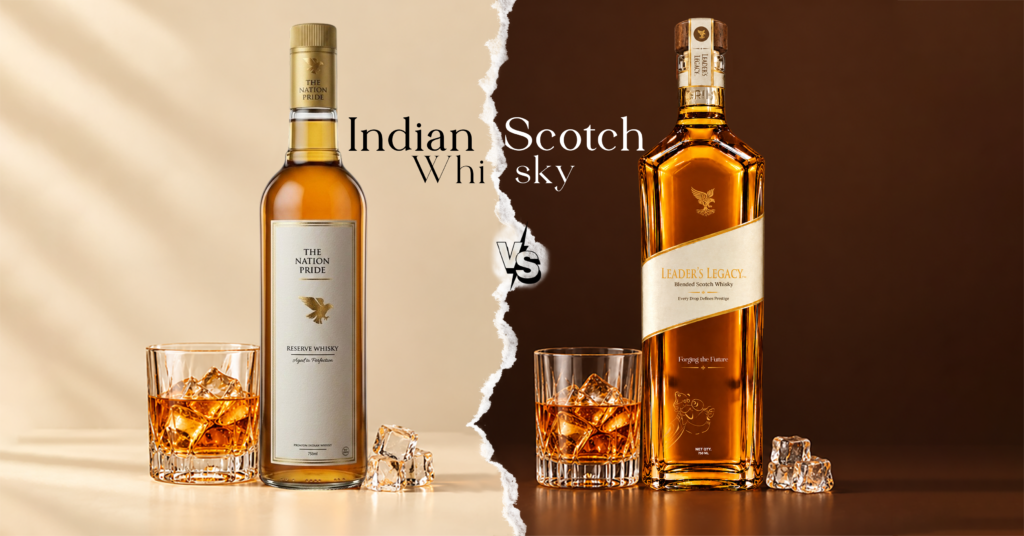
Whisky is a common drink choice for fans of alcohol beverages across the globe. Still, while selecting the type of spirit, there is usually a question regarding Indian whisky vs Scotch differences. Although both belong to the same whisky category, their characteristics can vary depending on the type you choose.
Modern production processes and Indian tastes have shaped the unique character of Indian whisky. In contrast, Scotch whisky complies with strict laws and production processes typical of Scotland. Thus, knowing this information, one can make an informed decision.
Indian Whisky and Scotch: Origin
The first and foremost difference between these two beverages lies in the country from which they originate. Indian producers make Indian whisky in India, while Scottish producers make Scotch in Scotland.
India has a wide variety of whiskies and different methods of how whiskies can be manufactured depending on the grain and the process used. Additionally, considering the fact that the weather in India is warmer compared to that in Scotland, it can affect the process of aging.
To qualify as Scotch, producers must meet specific legal criteria. To be specific, Scottish producers manufacture and mature this type of whisky in Scotland. Thus, Scotch has its unique characteristics.
Indian Whisky vs Scotch: How Do They Produce Them?
Individual whisky brands use different production methods. However, there are common features typical of all types of whisky which include the preparation of grains, fermentation, distillation, aging, and blending/bottling.
For example, Indian producers can use different grains, such as malted barley, other cereals, or grain spirit, to make whisky. Moreover, Indian producers can use different methods to make whisky.
Scotch producers emphasize malted barley for single malt Scotch and combine malt and grain whisky for blended Scotch. Scottish distillers distil Scottish distillers distil the whisky in Scotland and mature it in oak barrels.
Thus, the issue of Indian whisky vs Scotch is not that one is better than the other.
Comparison between Indian Whisky and Scotch – Differences in Taste and Flavour
Taste is one of the main reasons why people tend to compare Indian whisky and Scotch. However, flavour depends on the specific whisky rather than the country where it is made.
Indian whisky comes in various forms and includes such notes as smooth, rich, sweet, spicy, fruity, and woody. Warm Indian weather can also affect maturation and flavour.
The range of Scotch whisky is also quite diverse. It can be fruity, malty, honeyed, smoky, peaty, spicy or have a taste resembling vanilla depending on the area, production and maturation process.
For instance, some Scotches have smoky and peaty flavour profiles, and there are also those which give the impression of being fruity and light. Similar to Scotch, Indian whisky can be either easy or rich.
Climate and the Process of Aging of Whisky
The climate is one of the factors influencing whisky aging process. Producers mature whisky in wooden casks, while temperature changes influence the aging process.
Indian climate is generally warmer than that of Scotland. Therefore, the aging process of whisky may differ under Indian climatic conditions due to the increased interaction of the spirit with wood, depending on various factors such as a warehouse, cask, etc.
As for Scotland, the climate there is cool and temperate. Thus, Scotch is generally aged in a different time frame.
However, a longer maturation period does not automatically produce better-quality whisky.
Comparison of Indian Whisky with Scotch: Aging and Quality
Aging is yet another issue of comparison for many. The general assumption made by most individuals is that any whisky that is older will be better than its younger counterpart.
Whisky develops its taste through interaction with the cask. Consequently, maturation could bring tastes like vanilla, caramel, spices, fruits, oak or toasted wood.
Producers can choose to display the whisky’s age on Scotch bottles. When a Scotch bottle displays an age statement, that number represents the youngest whisky in the bottle.
Indian whisky producers may follow different approaches to age statements and production.
So, Which One Is for You?
Your personal taste ultimately determines whether you choose Indian whisky or Scotch. Indian whiskies may suit someone who loves their whisky according to Indian tastes.
But, should you want to go for the classic Scottish whiskies, there is a wide variety of options available under Scotch.
An option for a beginner would be to start with something that is easy to drink and tastes smooth. If one has been drinking whisky, they can opt for smoky, peaty, fruity, spicy, or woody tasting.
There isn’t a clear winner in the Indian whisky vs. Scotch battle. It all depends on what you expect.
The Nation Pride Whisky and Indian Whisky
Nation Pride Whisky is a representative of Indian whiskies and allows consumers to try out an Indian brand of whisky. The Nation Pride Whisky brand focuses on an approachable style designed for Indian whisky drinkers.
When comparing Indian whisky with Scotch, consider flavour, aroma, smoothness, production process, and individual preferences.
For people who are interested in whiskies, this can be a fun way to see how different factors affect the result of drinking.
Frequently Asked Questions About Indian Whisky vs Scotch
Q1. Indian Whisky vs Scotch Whisky – Which Is Better For Beginners?
Beginners can enjoy either category, depending on their personal preferences. However, for the beginners, it will be more pleasant to drink whisky which is smooth and easy to drink. Thus, it depends on personal preferences.
Q2. Which is the Difference Between Indian Whisky vs Scotch?
Indian whisky and Scotch differ in origin, production, ingredients, aging, and flavour. Indian whisky is made in India, while Scotch whisky is supposed to be made and aged in Scotland.
Q3. Does Indian Whisky Mature Faster Than Scotch?
Climate in India is warmer than in Scotland. This may affect the process of maturing. Nevertheless, maturing is influenced by many factors like type of cask, warehouse, temperature, humidity and whisky itself.
Q4. Is Scotch Always More Expensive Than Indian Whisky?
Not necessarily. Price differences are significant both within and between those categories. Many factors can play their role – ingredients, cost of production, maturing, selection of casks, brand marketing, taxes, packaging and distribution.
Q5. Can Indian Whisky Taste Smooth Like Scotch?
Yes, Indian Whisky can be smooth tasting. However, smoothness depends on particular whisky, its production, maturing, blending, individual taste etc. Thus, individual bottles should be compared, not whole categories.